How Bond Income Works: Why a Low Coupon Doesn't Mean a Low Return
By Jonathan Smith, CFP® Lead Financial Planner | Published 11/2/2026
The short answer: Bond income comes from two sources: coupon income (the interest a bond pays) and price appreciation (the gain from buying below face value and being repaid at par). Together they make up your bond's total return. A bond with a low coupon can have the same total return as a bond with a high coupon.
Key takeaways
Total return = coupon income + price appreciation.
A bond bought at a discount earns part of its return from price appreciation, not interest.
A bond bought at a premium gives up some of its coupon to the higher purchase price.
Judge a bond by its total return, not by its coupon alone.
What are the two components of bond income?
Coupon income: the interest the bond pays you along the way.
Price appreciation: the gain when you buy a bond for less than its face value and receive the full face value at maturity.
Bond terms every investor should know
Bond: a loan from an investor to an issuer, usually a government or a business.
Par (face) value: the amount paid back to the investor at maturity.
Maturity date: the date the investor gets their money back.
Coupon: the interest rate the bond pays.
Discount: when a bond sells for less than its face value, such as a $100 bond selling for $98.
Premium: when a bond sells for more than its face value, such as $100 bond selling for $102.
For simplicity, every example below assumes the bond is bought at issue and matures in one year. In practice, bonds have many different maturities and are often purchased after issue, but the principle is the same.
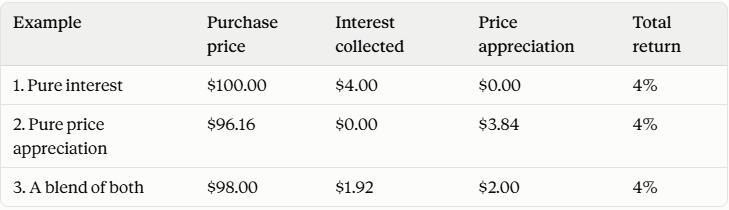
How do three bonds reach the same 4% total return?
Example 1: Pure interest. You buy a $100 bond for $100, collect $4 in interest, and get $100 back. The full 4% arrives as cash flow.
Example 2: Pure price appreciation. You buy a $100 bond for $96.16, collect no interest, and receive $100 at maturity. The $3.84 gain comes entirely from price appreciation.
Example 3: A blend. You buy a $100 bond for $98, collect $1.92 in interest, and receive $100 at maturity. That's $2 of appreciation plus $1.92 of interest, or $3.92 in total.
Why is my bond showing no gain on my statement?
This is one of the most common questions we hear. If you bought a bond at par and it pays interest, your return shows up as cash flow, not as a gain in value. You're still earning. In Example 1, the 4% return is real even though the price never changed.
Why is my bond's interest rate so low?
If your bond pays a low coupon, such as 1.9%, but current rates are closer to 4%, part of your total return is likely coming from price appreciation. A bond bought at a discount pays you the difference between the purchase price and par when it matures. The coupon is only one piece of the picture.
Frequently asked questions
What is a bond coupon?
The coupon is the interest rate a bond pays, based on its face value.
What is total return on a bond?
Total return is the combined result of the interest a bond pays and any gain or loss in price between purchase and maturity.
What does it mean when a bond sells at a discount?
The bond is priced below its face value. If held to maturity, the investor receives the full face value, which creates price appreciation.
What does it mean when a bond sells at a premium?
The bond is priced above its face value. The extra amount paid reduces the investor's total return compared with the coupon rate alone.
Can two bonds with different coupons have the same return?
Yes. Differences in purchase price can offset differences in coupon, as in the 1.75% and 4.25% examples above.
The bottom line
When you evaluate a bond, or read your statement, look beyond the coupon to the total return.
This article is provided for informational purposes only and should not be construed as legal, tax, or financial advice. The information presented is based on sources believed to be accurate and reliable. However, economic conditions, laws, and regulations are subject to change, and the information may no longer be true. Any examples provided are for illustrative purposes only and are not intended to guarantee or imply that similar results will be achieved. The information contained in this article is also not intended to constitute, and should not be considered a substitute for, personalized investment advice from Pathway Financial Advisors, LLC. A current or prospective client should not view this article as a guarantee of any particular level of investment performance or satisfaction if Pathway Financial Advisors, LLC is engaged, or continues to be engaged, to provide investment advisory services. Readers should consult with their financial advisor or other qualified professional before making any investment decisions.